
Union Jack Meaning – Why It Matters to Armed Forces
For every British serviceman or woman, the Union Jack is more than just a flag—it is a living emblem of unity and service. Whether saluted on parade or hoisted above HMS Victory, its design reflects centuries of courage and national evolution. This article breaks down the flag’s origins, purpose, and military protocols, showing why the Union Jack symbolises both national identity and the shared sacrifice of those who serve.
Table of Contents
- Defining The Union Jack And Its Purpose
- Origins And Evolution Of The Flag’s Design
- Symbolism In British Military Traditions
- Union Jack Protocols And Military Usage
- Addressing Myths And Common Misconceptions
Key Takeaways
| Point | Details |
|---|---|
| Significance of the Union Jack | The Union Jack represents the unity of England, Scotland, Wales, and Northern Ireland, symbolising military tradition and national identity. |
| Ceremonial Importance | The flag is an integral part of military ceremonies, signifying authority, historical continuity, and shared sacrifice among personnel. |
| Protocols for Display | Strict protocols govern the handling and display of the Union Jack, reinforcing respect, discipline, and professionalism within the armed forces. |
| Evolution and Identity | The flag has evolved over centuries, reflecting political changes, and serves as a living symbol of unity that motivates personnel in their service. |
Defining the Union Jack and Its Purpose
The Union Jack is far more than a flag hanging in a barracks or displayed at ceremony. It’s the national flag of the United Kingdom, representing the union of England, Scotland, Wales, and Northern Ireland under one Crown.
For those serving or having served, understanding what this flag means goes beyond textbook history. It connects you directly to centuries of British military tradition and sacrifice.
What the Union Jack Represents
The flag embodies three historical unions. The cross of Saint George (England), Saint Andrew (Scotland), and Saint Patrick (Ireland) are woven together into a single design that symbolises unity and collective strength.
When the Union Jack was flown as a battle ensign by Royal Navy vessels, it served a practical purpose—identifying British warships during combat. But it also represented something deeper: the combined power of a unified nation at sea.
Why It Matters to the Armed Forces
The flag isn’t just decoration for military personnel. Consider these core purposes:
- Identifies British forces in operations and on the battlefield
- Represents duty, valour, and honour expected in military service
- Connects historical sacrifice to contemporary operations
- Symbolises the nation you serve, not just a government or regime
- Unites personnel across all three services—Army, Navy, and Air Force
On ceremonial occasions like Trafalgar Day, the flag is raised aboard HMS Victory to honour naval heritage and the courage demonstrated in battle. This isn’t nostalgia—it’s a deliberate act connecting present service to past sacrifice.
The Practical and Symbolic Divide
The flag operates on two levels for military personnel. Practically, it identifies you as British military. Symbolically, it represents the covenant between the nation and those who serve it.
When you wear a uniform beneath the Union Jack, you’re part of a continuity stretching back to the Acts of Union. Understanding military regalia and insignia helps explain how these symbols communicate rank, role, and unit loyalty.
The flag acknowledges that you’ve sworn an oath to the Crown and the nation—not to politicians or institutions, but to the constitutional order the flag represents.
Pro tip: When displaying the Union Jack in a military setting, ensure it’s flown above regimental colours and properly retired at sundown—this small act reinforces the respect and discipline that define professional military service.
Origins and Evolution of the Flag’s Design
The Union Jack wasn’t created overnight. Its design evolved across three centuries, with each addition reflecting real political changes and negotiations between nations. Understanding this history helps explain why the flag carries such weight for military personnel today.
The flag’s journey is one of gradual integration and compromise—nations keeping their symbols whilst creating something unified.
The Beginning: 1606
When King James I united the English and Scottish crowns in 1603, a new flag was needed. In 1606, designers combined the Cross of Saint George (England’s symbol) with the Cross of Saint Andrew (Scotland’s symbol) to create the first Union Jack.
This wasn’t merely decorative. The Union Jack’s design evolved to represent political union between nations. Ships at sea needed visual identification, and this flag served that purpose whilst announcing a unified British presence.
The Irish Addition: 1801
Almost two centuries later, the design changed again. After the Act of Union with Ireland in 1801, the Cross of Saint Patrick was woven into the flag’s pattern. This created the Union Jack you see today.
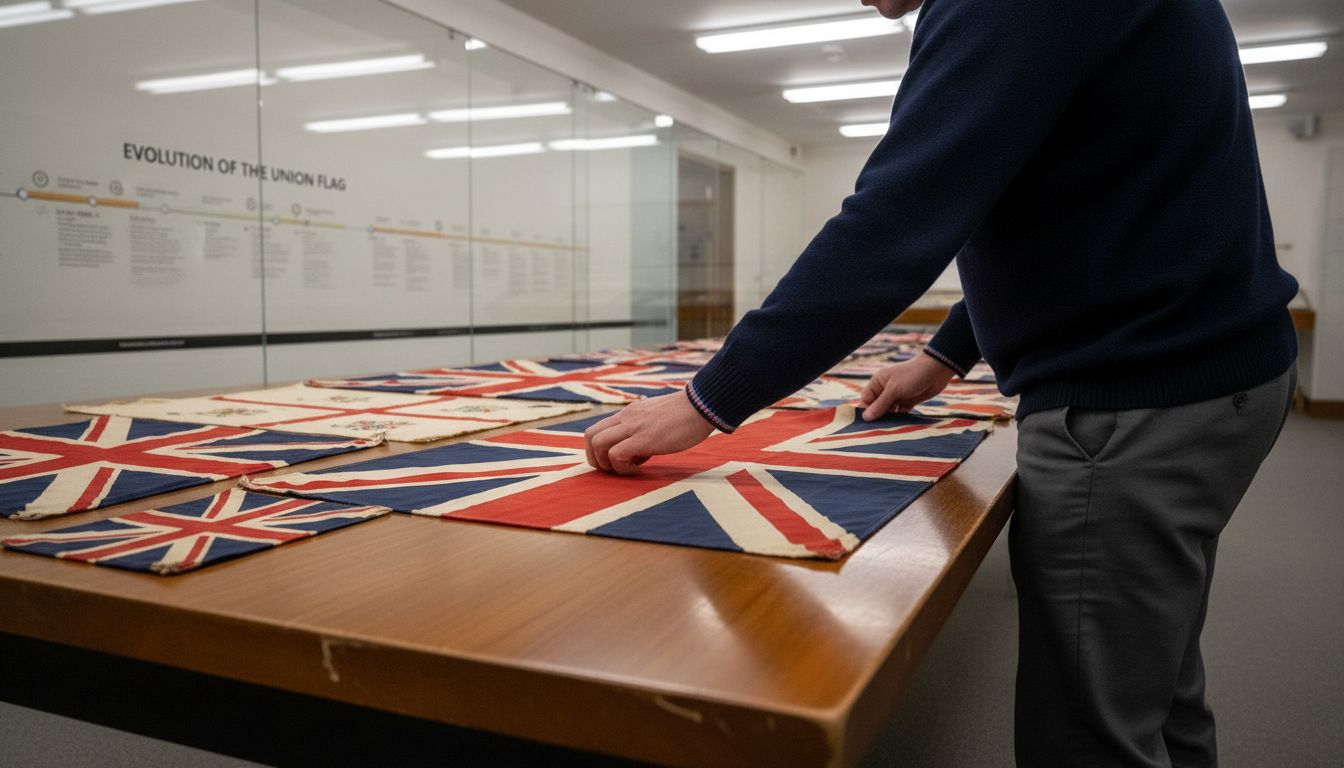
The addition wasn’t straightforward. Designers had to balance three crosses without one dominating the others—a literal representation of negotiating national interests into one design. Each nation’s emblem remained visible, yet subordinate to the whole.
To clarify the evolution of the Union Jack, here is a summary of each major design change:
| Year | Key Change | Symbol Added | Historical Context |
|---|---|---|---|
| 1606 | First design | Saint George & Saint Andrew crosses | Union of England and Scotland |
| 1801 | Second design | Saint Patrick’s cross | Act of Union with Ireland |
| Present | Unchanged since 1801 | All three crosses combined | Symbol of unified UK identity |
Why This Matters for Armed Forces Personnel
The flag’s evolution tells you something crucial about British military service:
- Unity came through negotiation, not conquest
- Each nation retained identity whilst accepting a larger union
- Symbols matter—they communicate legitimacy and collective purpose
- Design reflects political reality—three times the flag changed because the nation changed
- You serve something bigger than a single region or interest
The flag’s modifications demonstrate Britain’s historical and political development, symbolising unity amid diversity in ways that directly connect to your service today.
Design Principles Still Recognisable Today
Every serving member knows the flag instantly. This isn’t accidental. The flag originated as a naval identifier with clear, bold proportions designed for recognition from distance. Even in poor visibility at sea, the pattern remained unmistakable.
This practical design heritage explains why the Union Jack remains unchanged since 1801. It works. It communicates. It’s instantly recognisable on the battlefield, in barracks, and at ceremony.
Pro tip: When discussing the flag’s history with personnel new to service, emphasise that its three crosses represent ongoing political and national commitments, not historical relics—this perspective connects them to something living and contemporary.
Symbolism in British Military Traditions
The Union Jack isn’t simply flown at military establishments. It operates as a living symbol within traditions that connect you to centuries of service, sacrifice, and national identity. Every ceremony, every parade, every formal occasion reinforces what the flag means to those wearing the uniform.
For serving personnel, understanding these symbolic roles transforms how you relate to the flag—from decoration to covenant.
The Flag in Formal Military Ceremonies
When the Union Jack appears in formal military settings, it carries specific ceremonial weight. The Union Jack and other military flags hold deep symbolic value in ceremonies, such as when new Colours are presented by the monarch.
These aren’t casual events. The presentation of Colours represents a formal transfer of sovereign authority and trust to military units. The Union Jack features prominently, reminding personnel that their authority derives from the Crown, not from institutions or command structures.
What the Flag Communicates in Military Context
The flag operates on multiple symbolic levels simultaneously:
- National identity—it declares you represent Britain, not a faction or region
- Historical continuity—it connects current operations to past struggles and victories
- Sovereign authority—it embodies the Crown’s delegation of power to the armed forces
- Shared sacrifice—it honours those who served before you
- Esprit de corps—it unites personnel across ranks, services, and specialisms
When you stand at attention before the flag during a formal ceremony, you’re acknowledging all of these meanings simultaneously.
Honouring Sacrifice and Legacy
The Union Jack plays a crucial role in military traditions, symbolising national identity and the historical legacy of British naval power. It is flown to honour sacrifices made by service personnel and to assert the presence of the British armed forces.
This isn’t abstract remembrance. When the flag flies at half-mast, or when it’s folded with precise ceremony, these actions carry emotional weight because they acknowledge real losses.
The ceremonies centring on the Union Jack strengthen esprit de corps and connect current military personnel to established traditions—creating continuity between past sacrifice and present service.
The Flag as Unit Identity
Your unit’s relationship with the flag extends beyond national symbolism. Regimental colours—which typically incorporate the Union Jack—become personal to your battalion, squadron, or ship. You defend them, care for them, and treat them as sacred objects.
This transforms the flag from a national symbol into a unit emblem that represents your specific community of service. You’ve sworn to protect it. You’ll carry it into operations. You’ll retire it with ceremony.
Symbolism That Motivates Action
The Union Jack’s symbolic power isn’t decorative—it influences behaviour. Personnel march with greater purpose beneath it. Decisions about honour and conduct reference it implicitly. Sacrifice becomes comprehensible because the flag contextualises individual effort within something larger than personal interest.
This is why understanding the symbolism matters practically, not just historically. The flag shapes how military personnel think about duty and responsibility.
Pro tip: When training new personnel, explain that ceremonies involving the flag aren’t traditional for tradition’s sake—they’re psychological and cultural mechanisms that reinforce commitment to service and collective identity.
Union Jack Protocols and Military Usage
The Union Jack isn’t displayed casually in military settings. Strict protocols govern when, where, and how it’s used—and these rules exist for good reason. Understanding them reflects your professionalism and respect for what the flag represents.
These aren’t arbitrary restrictions. They’re practical standards that maintain the flag’s dignity and ensure consistent messaging across the armed forces.
How the Flag is Used in Military Operations
The Union Jack is used under strict protocols within military operations, from ceremonial occasions to battlefield identification. It is flown on ships, worn as insignia, and displayed during official military events.
Each context requires different handling. A flag flown on a warship operates under maritime protocols. A flag worn as shoulder insignia follows uniform regulations. A flag displayed at a ceremony adheres to specific positioning rules.
Core Protocol Requirements
Military protocol dictates specific standards for flag usage:
- Never allow the flag to touch the ground during handling or display
- Raise and lower the flag deliberately, never hastily or carelessly
- Position the flag above other regimental colours or unit insignia
- Retire damaged flags with ceremony, never disposal as waste
- Display the flag from sunrise to sunset unless on operational deployment
- Fold flags with precision using traditional military folds
These aren’t ceremonial niceties. They’re practical standards that prevent disrespect and maintain discipline.
Positioning and Display Standards
Where the flag appears communicates rank and importance. The Union Jack placed at the right-hand position (viewer’s right) takes precedence. This positioning reflects honour and priority.
On ships, the flag flies from the stern (rear) during normal operations. In barracks, it occupies a position of prominence. During parades, it leads or occupies the centre position. Each placement has specific meaning.
Insignia and Personal Display
Wearing the Union Jack as part of uniform insignia requires matching protocols. Shoulder badges, cap badges, and patches incorporating the flag must be properly positioned and maintained. Military insignia communicates rank, role, and unit loyalty in ways that extend to flag-based elements.
Damaged flag insignia should be replaced promptly. Faded patches undermine the visual impact and appear unprofessional.
Ceremonial Handling Standards
Ceremonial occasions demand precise flag handling. Two-person flag folding ceremonies follow specific movements. The flag never touches the ground during these procedures. Timing is deliberate—raising takes approximately one minute, lowering approximately two minutes.
Protocol dictates the Union Jack’s proper handling and positioning, underscoring respect and the flag’s role as a symbol of national unity and military pride.
Deployment and Operational Usage
During operational deployments, the flag serves identification purposes. Ships carry it for visual recognition. Personnel wear it for national identification. Established positions ensure consistency across all operations.
Operational contexts may modify ceremonial protocols slightly, but the core principle remains constant: the flag receives respectful, dignified handling at all times.
Pro tip: Learn the precise flag-folding technique from an experienced non-commissioned officer rather than attempting it alone—this ensures consistency and demonstrates respect for the tradition when you execute it formally.
Addressing Myths and Common Misconceptions
Plenty of confusion surrounds the Union Jack. Some myths persist because people haven’t encountered accurate information. Others arise from casual misuse or deliberate misrepresentation. As military personnel, understanding the facts protects the flag’s integrity and your credibility.
Misconceptions damage respect. Correcting them matters more than you might think.
Myth: The Union Jack and Union Flag Are Different Things
Many people use these terms interchangeably, but this creates confusion. The Union Jack is technically the flag when flown at sea or used as a jack (a flag flown from a ship’s bow). The Union Flag is the same flag in all other contexts.
In practical military usage, most personnel refer to it simply as the Union Jack regardless of context. This casual approach is acceptable, but understanding the distinction shows deeper knowledge.
Myth: The Flag Has a Correct Orientation
Common misconceptions about the Union Jack include misunderstandings about its design, such as incorrect orientations. The truth is the flag has no “upside down” version in the traditional sense.
The flag’s design is nearly symmetrical. Rotating it 180 degrees produces a visually similar result. However, protocol dictates a proper orientation: the widest white diagonal stripe should appear at the top-left corner. This establishes consistency.
Myth: It’s Only Used as a Maritime Flag
This misconception persists because the flag originated for naval identification. However, the flag’s historical context dispels myths about its use solely as a maritime flag, demonstrating its broader symbolic importance for the nation and armed forces.
Today the Union Jack appears everywhere in military contexts—on uniforms, in barracks, at ceremonies, and during parades. It serves national, not just maritime, purposes.
Myth: The Union Jack Is Interchangeable With Other Ensigns
This confusion damages understanding. Military practice clearly distinguishes the Union Jack from the White Ensign (Royal Navy) and the Red Ensign (merchant vessels).
Each flag communicates different authority and context:
Here is a quick reference comparing the Union Jack with other major British flags used in military and maritime contexts:
| Flag | Main Use | Authorising Body | Typical Setting |
|---|---|---|---|
| Union Jack | National, armed forces | United Kingdom Government | Military, national ceremonies |
| White Ensign | Royal Navy warships | Royal Navy | Naval vessels and establishments |
| Red Ensign | Merchant shipping | Maritime and Coastguard Agency | British merchant ships |
| Blue Ensign | Reserved navy and official uses | Royal Naval Reserve | Naval Reserve vessels |
- Union Jack—national symbol, general military use
- White Ensign—Royal Navy authority and sovereignty
- Red Ensign—merchant marine and civilian shipping
- Blue Ensign—Royal Naval Reserve and certain official vessels
Flying the wrong flag signals confusion about authority or purpose.
Myth: The Flag’s Design Never Changed
This is incorrect. The flag evolved three times as the United Kingdom’s political composition changed. Each modification was deliberate, not accidental.
Scholarly research and official records maintain the flag’s true heritage and demonstrate its respectful use evolves with national circumstances.
Myth: Respectful Display Doesn’t Really Matter
This attitude undermines military discipline. Protocol exists because symbols matter. How you handle the flag communicates whether you take your service seriously. Casual treatment invites others to treat it casually.
Proper display, correct folding, and dignified handling reinforce that the flag represents something serious—not decoration, but national identity and collective sacrifice.
Pro tip: When correcting misconceptions about the flag, cite the specific protocol or historical fact rather than opinion—this builds credibility and helps others understand the flag’s genuine importance to military service.
Honour Tradition with Authentic British Military Gifts
Serving under the Union Jack demands a deep respect for its meaning and symbolism. This article highlights how the flag represents unity, sacrifice, and a solemn covenant between the nation and its Armed Forces. Whether you are a serving member or a proud veteran, expressing this connection through quality regalia and presentation products strengthens your bond with British military heritage.
Explore an exclusive selection of UK Military gifts designed to reflect the values embodied by the Union Jack. From regimental insignia to presentation items that honour your commitment, find meaningful ways to celebrate your service. Visit Regimental Store today and choose items crafted with the same precision and respect that the flag demands. Act now to own a piece of tradition that inspires pride and unity within every British Army, Royal Navy, and RAF member.
Frequently Asked Questions
What does the Union Jack represent?
The Union Jack represents the unity of England, Scotland, and Northern Ireland, symbolising collective strength through the crosses of Saint George, Saint Andrew, and Saint Patrick.
How does the Union Jack relate to military personnel?
The Union Jack identifies British forces, embodies values such as duty and honour, connects personnel to historical sacrifices, and represents the nation they serve.
Why is the Union Jack important in military ceremonies?
In military ceremonies, the Union Jack carries significant ceremonial weight, symbolising sovereign authority, national identity, and shared sacrifice of service personnel.
What are the protocols for displaying the Union Jack in military settings?
Protocols include never allowing the flag to touch the ground, positioning it above regimental colours, and carefully retiring damaged flags with ceremony to maintain respect and dignity.
Recommended
- Remembrance Day: Why it Matters for UK Forces – The Regimental Store Ltd
- Cap Badges Explained: Meaning for UK Forces – The Regimental Store Ltd
- Royal Artillery: Why It Matters for UK Defence – The Regimental Store Ltd
- Types of Military Regalia in the UK Forces – The Regimental Store Ltd
- Licensed Chauffeur Meaning – Why It Matters