
Meaning of Challenge Coins in UK Military Life
Receiving a challenge coin from a respected commanding officer is a moment that stays with you long after your service ends. For many in the British Army and among veterans, these coins embody much more than metal—they reflect membership, honour, and shared service within the armed forces. Understanding their significance reveals the deep roots of military camaraderie, the personal recognition behind each coin, and how these small tokens unite generations through tradition and pride.
Table of Contents
- Meaning Of Challenge Coins In Military Tradition
- Distinct Categories And Designs Across Uk Forces
- Rituals, Presentation, And How Coins Are Used
- Legal Status And Ethical Responsibilities
- Common Misconceptions And Mistakes To Avoid
Key Takeaways
| Point | Details |
|---|---|
| Significance of Challenge Coins | Challenge coins symbolise membership, honour, and shared service in the military, creating a profound sense of camaraderie among personnel. |
| Presentation and Ritual | The ceremonial presentation of challenge coins enhances their significance, making the moment memorable and impactful for both recipients and witnesses. |
| Ethical Considerations | Challenge coins must be awarded for genuine achievements, and their use should adhere to established military codes of conduct to maintain their integrity. |
| Distinctive Designs | Each branch of the UK armed forces has unique challenge coin designs reflecting their identity and heritage, reinforcing a sense of belonging within specific units. |
Meaning of challenge coins in military tradition
Challenge coins represent far more than small metal discs. They embody membership, honour, and shared service within the armed forces, carrying weight that belies their modest size.
These custom medallions, typically featuring an organisation’s insignia, serve as tangible recognition of exceptional achievements and milestones. When a commanding officer presents you with a challenge coin, they’re acknowledging your contribution in a deeply personal way. It’s a moment that resonates differently than a written commendation.
The significance runs deep. Challenge coins foster camaraderie and pride amongst service personnel, binding individuals through shared experiences and mutual respect. They symbolise unity across ranks and regiments, creating a physical reminder of belonging to something greater than yourself.
Historical Roots and Modern Practice
The tradition stretches back further than many realise. Challenge coin origins trace to ancient Rome, where soldiers received special coins honouring their bravery and service. This practice evolved through centuries, gaining particular prominence in twentieth-century military culture.
Within UK military and emergency services today, challenge coins maintain their core purpose: recognising and honouring personnel. They often commemorate:
- Special military operations or campaigns
- Significant service milestones and anniversaries
- Exceptional individual achievements
- Unit cohesion and team recognition
- Ceremonial occasions and formal events
These coins become tangible reminders of pivotal moments. Veterans carry them decades after leaving service, pulling them out during reunions or quiet moments of reflection. The coin itself becomes a token of connection to those who shared the experience.
Why They Matter to Service Personnel
Unlike medals worn on dress uniforms, challenge coins live in your pocket or on your shelf. You hold them, feel their weight, remember the moment they were presented. This tactile quality makes them profoundly personal.
For senior officers and those transitioning to civilian life, challenge coins represent validation. They acknowledge sacrifice, dedication, and moments when you made a difference. They’re conversation starters with fellow veterans, instant proof of shared understanding.
Challenge coins transform abstract concepts like honour and service into something you can hold in your hand.
They also serve a practical purpose in unit cohesion. The presentation itself—often informal yet ceremonial—strengthens bonds between commanding officers and personnel. It signals that leadership notices effort and values contribution.
Pro tip: Display your challenge coins where you can see them regularly, perhaps on a shelf or in a dedicated case, as a daily reminder of your achievements and the camaraderie you’ve built throughout your military service.
Distinct categories and designs across UK forces
Each branch of the UK armed forces maintains its own challenge coin designs, reflecting distinct identities and values. These aren’t interchangeable tokens—they’re carefully crafted symbols of belonging to a specific tradition.
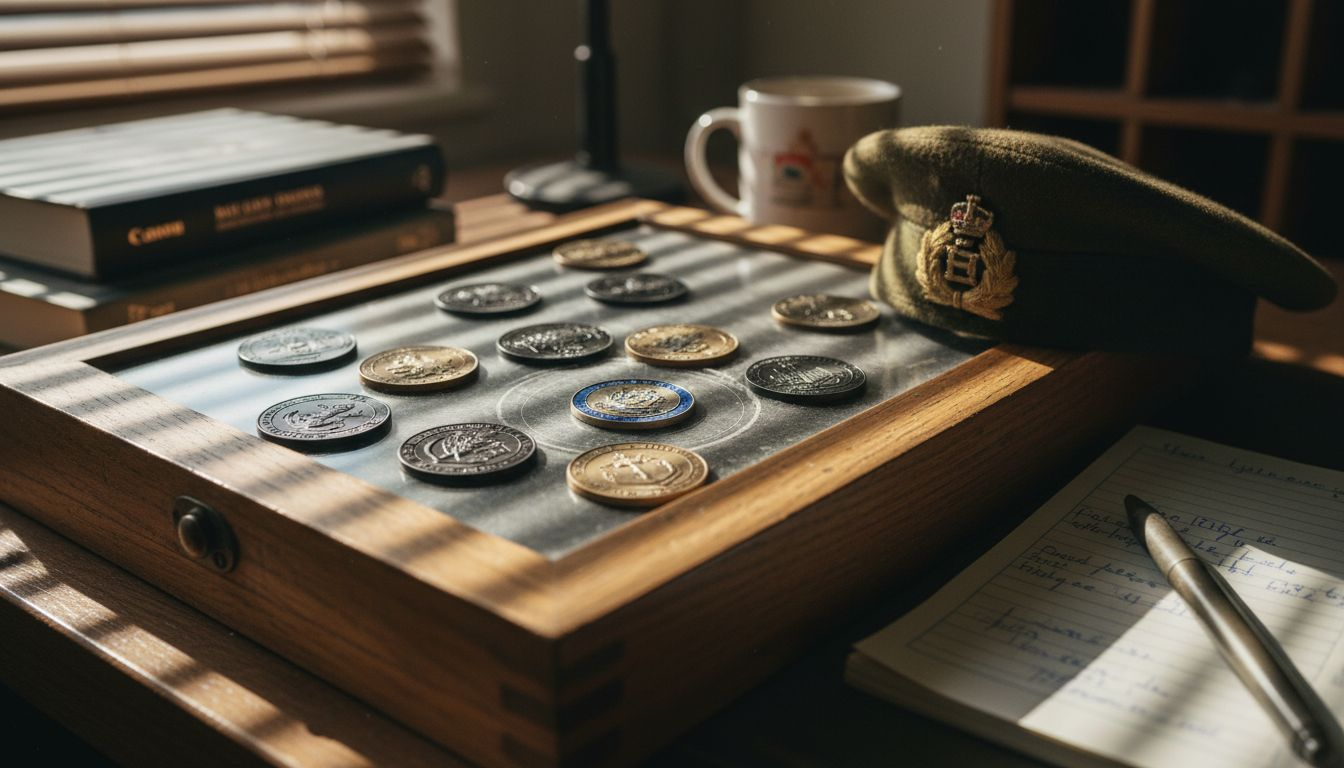
The designs vary considerably across regiments, squadrons, and operational units. What makes them unique is how they capture the essence of each organisation’s history, mission, and personnel. A Royal Navy coin looks nothing like an RAF coin, and that difference matters.
British Army Challenge Coins
British Army challenge coins incorporate unit insignia that tell stories of service and achievement. These tokens symbolise a soldier’s dedication and accomplishments within their specific regiment or battalion.
Designs often feature:
- Regimental crests and emblems
- Unit mottos and traditions
- Historical symbols reflecting operational heritage
- Distinctive colours and metallic finishes
- Commemorative dates or campaign references
A notable example is the British Assault Rifle Coin, which signifies marksmanship proficiency and specialised weapons training. It’s awarded to those who’ve demonstrated exceptional competency, making it a mark of recognised skill rather than mere participation.
Each regiment works closely with designers to ensure their coins authentically represent their character. You won’t mistake a parachute regiment coin for an engineer’s token—the symbolism runs too deep.
Royal Air Force Challenge Coins
RAF challenge coins carry rich histories of bravery, teamwork, and honour. They feature emblems and mottos unique to each air force unit and squadron.
These coins often display:
- Squadron crests and aircraft insignia
- Flying hours or operational milestones
- Air defence or transport specialisations
- Pilot wings and navigator symbols
- Commemorative operational designs
Each force’s coins become badges of honour, instantly recognisable to those within the service and valued by veterans long after retirement.
Airmen and airwomen receive these coins for exceptional performance, leadership, or completion of demanding training programmes. The design’s sophistication reflects the technical precision required in aviation roles.
Royal Navy and Other Service Branches
Naval challenge coins feature maritime symbolism—anchors, ships, and naval crests are standard design elements. Submarine service coins, for instance, incorporate specific boat names and operational histories.
Specialised forces like the Royal Marines develop coins reflecting their amphibious and commando heritage. Each design tells a story of the unit’s unique role within the armed forces.
To better understand the differences between challenge coins across the UK armed forces, see the comparative summary below:
| Branch | Typical Coin Symbols | Primary Purpose | Notable Distinction |
|---|---|---|---|
| British Army | Regimental crests, mottos | Honours service and achievement | Unique to each regiment |
| Royal Air Force | Squadron emblems, wings | Marks exceptional performance | Aviation-focused symbolism |
| Royal Navy | Anchors, ships, crests | Celebrates maritime service | Naval heritage emphasis |
| Royal Marines | Commando motifs | Recognises amphibious skill | Bold, specialist designs |
Pro tip: When receiving or presenting a challenge coin, research its specific design elements and history—this knowledge deepens the appreciation and shows respect for the tradition and unit’s achievements.
Rituals, presentation, and how coins are used
Challenge coins aren’t simply handed over like a standard award. The presentation itself is ceremonial, transforming a moment of recognition into something memorable and meaningful.
When a commanding officer presents you with a challenge coin, they’re acknowledging your contribution in front of peers. This public recognition carries weight that a private commendation never could. The ceremony reinforces bonds between leadership and personnel, signalling that your effort matters.
Formal Presentation Ceremonies
Challenge coins are awarded during formal ceremonies to recognise service members’ achievements and exceptional performance. These presentations typically occur in front of your unit, making the honour visible to everyone.
Formal presentations often happen:
- At unit parades or formal occasions
- Following successful operations or deployments
- Upon completion of demanding training courses
- During regimental anniversaries or significant milestones
- At retirement ceremonies for departing personnel
The ceremony adds gravity to the award. You remember exactly where you were, who was present, and what the commanding officer said. That memory lasts decades.
The Coin Challenge Ritual
Once you possess a challenge coin, you enter a uniquely military tradition. The coin challenge is a social ritual where members present their coins to one another as a bond test.
Here’s how it works:
- One person calls out a challenge (often in a pub or social setting)
- All present must produce their coin immediately
- Those who cannot produce their coin must buy drinks for the challenger
- Those who produce their coins in time win a drink from the challenger
It sounds lighthearted, yet it serves serious purpose. Traditional coin challenges reinforce esprit de corps amongst service members, maintaining connection long after service ends.
Veterans carry their coins specifically for this reason. You’ll see retired officers keeping their coins in wallets or pockets, ready for the moment a fellow veteran issues a challenge.
The coin challenge transforms a simple object into a living connection between service members, past and present.
Coins as Mementos and Symbols
Beyond ceremonies and challenges, coins serve as tangible mementos of significant moments. They commemorate deployments, special operations, or milestones within your unit.
Keeping your coins means:
- Preserving memories of achievements
- Maintaining connection to your unit and peers
- Honouring the moments when leadership recognised your contribution
- Creating artefacts for future reflection
Many veterans display their coins at home, not for vanity, but as reminders of service and sacrifice. The coin becomes a conversation piece with family, a way of explaining what your military life meant.
Pro tip: Keep your challenge coins in a secure, accessible place—whether a display case or your wallet—so you’re always prepared if a fellow veteran issues a challenge, maintaining the tradition wherever you go.
Legal status and ethical responsibilities
Challenge coins exist in a unique space within British military culture. There is no specific UK legislation governing their use or distribution, yet they remain subject to established codes of conduct and organisational guidelines that officers and service members must respect.
Understanding the legal and ethical landscape matters, especially when you’re presenting coins or receiving them. Misuse can damage the tradition and create serious consequences for your reputation and career.
The Legal Framework
UK military insignia on challenge coins falls under intellectual property protections and uniform regulations. The Ministry of Defence owns the rights to regimental crests, badges, and official symbols used on military coins.
This means:
- Only authorised units can produce coins featuring their official insignia
- Commercial use of military symbols without permission violates intellectual property law
- Counterfeiting or misrepresenting military coins is illegal
- Unauthorised reproduction of regimental crests carries legal liability
- Third-party manufacturers must work directly with military units
You cannot legally create and sell challenge coins bearing military insignia without explicit permission from the relevant regiment or unit. Doing so exposes you to legal action and damages the integrity of the tradition.
Ethical Standards Within Military Culture
Beyond legality, ethical responsibility governs how coins are awarded and used. Military codes of conduct demand that coins represent legitimate recognition, not commercial exploitation or personal gain.
Ethical considerations include:
- Coins must be awarded for genuine achievement or service
- They should never be manufactured or sold for profit without authorisation
- Presenting false or misleading coins dishonours the tradition
- Coins from disbanded units or fraudulent sources undermine credibility
- Personal integrity must accompany any coin you receive or present
Veterans understand this intuitively. A coin from your commanding officer carries weight precisely because it represents honest recognition. Counterfeit or inappropriately awarded coins lose all meaning.
Here is a quick reference outlining legal and ethical considerations for handling challenge coins:
| Aspect | Legal Considerations | Ethical Guidelines |
|---|---|---|
| Production | Requires official permission | Must represent authentic recognition |
| Distribution | Prohibited for commercial resale | Presentation must be formal and justified |
| Use of Insignia | Protected by intellectual property law | Only awarded for genuine achievement |
| Misuse Consequences | Legal liability, damaged reputation | Loss of tradition’s integrity |
Challenge coins hold their power because they represent truth and earned recognition—break that covenant, and the coin becomes worthless.
Presenting and Receiving Coins Responsibly
When you present a challenge coin, you’re making a statement about someone’s service or achievement. That responsibility demands authenticity and accuracy.
If you’re commissioning custom coins for your unit, work exclusively with authorised manufacturers who understand military regulations. If you’re receiving a coin, verify its legitimacy—know the unit it represents and the circumstances of its award.
Misrepresenting your qualifications or service to receive a coin damages your credibility permanently. Fellow veterans recognise this immediately.
Pro tip: Before presenting or acquiring a challenge coin, verify it represents an authorised unit and was produced through legitimate channels—this protects both the tradition’s integrity and your own reputation.
Common misconceptions and mistakes to avoid
Challenge coins attract confusion precisely because they resemble ordinary medals or commemorative tokens. Many people misunderstand their purpose, leading to mistakes that undermine their significance within military culture.
Getting these details wrong matters. It signals a lack of respect for the tradition and can damage your credibility amongst fellow service members and veterans.
Confusing Challenge Coins with Generic Medals
A critical misconception is treating challenge coins as mere collectables or promotional items. Custom-minted coins differ fundamentally from authentic challenge coins in purpose, design, and meaning.
The key differences are:
- Challenge coins represent membership and honour within a specific unit or organisation
- Generic custom coins lack military insignia and ceremonial significance
- Authentic challenge coins are formally presented with ceremony
- Commercial coins sold as “challenge coins” often miss the point entirely
- Unit-specific coins carry historical and emotional weight that generic tokens cannot replicate
Just because a coin has a military theme does not make it a challenge coin. The authenticity comes from the unit that created it, the insignia it bears, and the circumstances of its presentation.
Misusing Coins Outside Proper Context
Challenge coins are serious symbols of camaraderie and honour, not party favours or casual giveaways. Using them informally in non-military settings trivialises their meaning.
Common mistakes include:
- Handing out coins without formal ceremony or justification
- Treating coins as merchandise to sell or trade
- Awarding coins to people who haven’t earned them
- Using coins in commercial contexts without authorisation
- Neglecting ceremonial practices that preserve their significance
When you receive a challenge coin, it should be a moment you remember. If coins are distributed casually, they lose that weight entirely.
Challenge coins derive their power from scarcity, ceremony, and honest recognition—misuse destroys everything that makes them meaningful.
Overlooking Presentation Rituals
Another mistake is ignoring the ceremonial aspects of challenge coin traditions. The way a coin is presented matters as much as the coin itself.
Avoiding this error means:
- Presenting coins formally, not casually
- Acknowledging the specific achievement being recognised
- Understanding the coin’s history and unit significance
- Following proper protocols established by your unit or organisation
- Never presenting a coin without clear justification
The ceremony transforms a piece of metal into a memory. Skip the ceremony, and you’re left with just a coin.
Pro tip: Before presenting a challenge coin, research its history, verify the recipient’s genuine achievement, and conduct the presentation formally—these steps preserve the tradition’s integrity and ensure the coin carries real meaning.
Honour Your Service with Authentic UK Military Challenge Coins
Understanding the deep meaning behind challenge coins reveals the true value they hold as symbols of membership, honour, and shared military tradition. Whether you are commemorating exceptional achievements, fostering unit cohesion, or preserving memories of service, owning an authentic challenge coin crafted with respect for UK military heritage connects you to that proud legacy. Avoid common pitfalls like unauthorised reproductions by choosing coins that carry official regimental insignia and reflect genuine recognition.
Explore a wide selection of authentic British Army, Royal Navy, and Royal Air Force challenge coins and presentation gifts designed to honour your commitment and sacrifices. Shop now at Regimental Store to find a meaningful token that celebrates your story and strengthens bonds with those who served alongside you. Do not miss the opportunity to preserve this time-honoured tradition by selecting a coin that truly captures your unit’s spirit and achievement today.
Frequently Asked Questions
What is the significance of challenge coins in military life?
Challenge coins symbolise membership, honour, and shared service among service personnel. They acknowledge exceptional achievements and foster camaraderie and pride within the armed forces.
How are challenge coins presented in formal military settings?
Challenge coins are awarded during formal ceremonies to recognise accomplishments and exceptional performance. These presentations enhance the significance of the honour by making it visible to peers.
What distinguishes challenge coins from other military awards?
Challenge coins are personal tokens, unlike medals. They reside in pockets or on shelves and serve as tangible reminders of service, whereas medals are typically worn on uniforms and represent broader military achievements.
Can anyone create or distribute challenge coins with military insignia?
No, only authorised units can produce challenge coins featuring military insignia. Misuse of such symbols can lead to legal consequences and undermines the integrity of the military tradition.
Recommended
- Commemorative Medals: Their Role in UK Military Heritage – The Regimental Store Ltd
- Why Display Military Badges: Honouring Service in the UK – The Regimental Store Ltd
- History of Armed Forces Gifts – Symbolism in Service – The Regimental Store Ltd
- What Is a Campaign Medal? Honouring UK Service – The Regimental Store Ltd
- Race Medals Every Milton Keynes Runner Should Know - MK Marathon Weekend, Milton Keynes 3-4 May 2026