
History of the Royal Marines – Why It Matters for Veterans
Every Royal Marine recognises the pride that comes from sharing a heritage stretching back to 1664, when the Duke of York and Albany’s Maritime Regiment of Foot created a role unlike any other in British military history. The blend of sea and land combat expertise set the early Royal Marines apart and established values that endure to this day. Exploring these origins offers veterans and serving Commandos a deeper understanding of where their distinctive spirit and reputation truly began.
Table of Contents
- Royal Marines Origins And Early Concept
- Major Regimental Changes And Milestones
- Key Battle Honours And Operations
- Transition To Commando Role And Elite Status
- Living Traditions And Impact On Veterans
Key Takeaways
| Point | Details |
|---|---|
| Origins of the Royal Marines | Established in 1664, the Royal Marines emerged from a practical need for skilled soldiers to operate in both naval and land environments, shaping British military capability. |
| Evolution into Commando Forces | World War II marked a significant transformation where Royal Marines transitioned to elite Commando forces, focusing on rapid deployment and specialised training. |
| Battle Honours and Adaptability | Royal Marines have demonstrated exemplary skills across various conflicts, establishing a legacy of excellence through adaptability to modern warfare challenges. |
| Living Traditions and Veteran Engagement | Engaging with regimental traditions and museums strengthens the sense of community and belonging among veterans, aiding in mental wellbeing. |
Royal Marines origins and early concept
The Royal Marines didn’t emerge from some grand strategic plan drawn up in a boardroom. They arose from a practical necessity that the Royal Navy faced in the 1660s. When fighting at sea, naval vessels required soldiers to defend ships, board enemy vessels, and secure positions during amphibious operations. This dual demand—needing both maritime expertise and land combat skills—led to the creation of something genuinely unique. In 1664, the Duke of York and Albany’s Maritime Regiment of Foot was established, and what began as a practical solution would fundamentally shape British military capability for centuries to come.
What set the early Royal Marines apart wasn’t just their location aboard ships. They represented a completely different approach to warfare. Unlike traditional army regiments stationed on land, these marines trained to operate in both naval and amphibious environments. They served as ship security, trained for boarding operations against enemy vessels, and prepared for rapid assaults on coastal positions. Think of them as the original specialists in amphibious warfare—a capability that wouldn’t be formally recognised and expanded until World War II, when the Commando units would build directly upon the traditions and expertise the Royal Marines had been developing for nearly 300 years. This foundation meant that when modern conflicts demanded rapid deployment from the sea onto hostile shores, the Royal Marines already possessed the institutional knowledge and training culture to execute such operations.
The early concept of the Royal Marines also embedded something less tangible but equally important: a distinctive commando spirit. From those first decades in the 1660s, the force cultivated values that persist today. Courage in dangerous situations. Determination when facing seemingly impossible odds. Cheerfulness even in adversity. These weren’t written into regulations because they were simply understood as essential to anyone who might find themselves boarding an enemy ship or launching a dawn attack on a fortified position. You weren’t just a soldier or just a sailor—you were both, and that meant accepting extraordinary challenges as routine. This psychological dimension of the early Royal Marines proved as important as any musket or sword they carried. For modern veterans, understanding these origins matters because it reveals where the ethos you’ve lived by for years actually comes from. It wasn’t invented yesterday or adapted from some other service. It emerged directly from the practical requirements of operating in the world’s most challenging environment: the intersection of sea and land.
Pro tip: If you’re interested in preserving your connection to Royal Marines history, personalised veterans memorabilia boxes allow you to curate and display artifacts that represent your own service while honouring the legacy that stretches back to 1664.
Major regimental changes and milestones
The Royal Marines didn’t remain static after their 1664 founding. By the early 1900s, the Corps had undergone significant structural reorganisation to meet evolving military demands. The force split into two distinct branches: the Royal Marine Light Infantry and the Royal Marine Artillery. This wasn’t simply bureaucratic shuffling. Each branch served specific operational purposes. The Light Infantry handled rapid boarding operations, amphibious assaults, and ship security, whilst the Artillery specialised in naval gunnery and fire support. These divisions operated from four home bases strategically positioned near Britain’s major naval ports, allowing rapid deployment wherever the Royal Navy sailed. What mattered most was that this reorganisation reflected a fundamental truth about the Royal Marines: they adapted constantly to stay relevant. When technology changed, when threats shifted, when naval doctrine evolved, the Corps reorganised itself to meet these new realities.
The most transformative period arrived during and after World War II. The Royal Marines transitioned from being primarily shipboard troops into something far more specialised: elite Commando forces. This shift wasn’t gradual. It was deliberate and dramatic. The wartime experience of amphibious operations, particularly in North Africa and Europe, revealed that traditional shipboard roles needed supplementing with a dedicated rapid-strike capability. Post-war, the Corps embraced this identity fully, focusing on Arctic warfare, amphibious assaults, and rapid deployment operations. Through the Cold War era, Royal Marines Commandos became synonymous with elite capability. They trained in extreme conditions, specialised in mountain and jungle environments, and prepared for operations requiring speed, precision, and absolute reliability. The evolution from traditional roles to Commando specialisation marked a watershed moment that fundamentally changed how the Corps operated and how other nations viewed British amphibious capability.
Since the Cold War’s end, the Royal Marines have continued this pattern of adaptation and expansion. The Falklands War in 1982 demonstrated their elite status decisively. Heavily outnumbered, operating in inhospitable terrain over 8,000 miles from home, Royal Marines Commandos secured victory through exceptional training, leadership, and determination. That achievement cementing their reputation as a versatile and elite fighting force. Beyond major conflicts, the Corps expanded its remit to include multinational exercises, humanitarian missions, and rapid-response deployments to emerging crises. They’ve integrated cutting-edge technology, participated in joint operations with allies from NATO to Australia, and adapted to contemporary security challenges ranging from piracy suppression to counter-terrorism. What connects every milestone from the 1900s reorganisation through today’s global deployments is this: the Royal Marines recognised early that standing still meant obsolescence. They transformed themselves repeatedly because the strategic environment demanded it. For modern veterans, these milestones represent more than historical achievements. They show how the institution you served evolved to meet unprecedented challenges whilst maintaining the core values established in 1664.
To understand how the Royal Marines evolved, here is a summary of key changes across different eras:
| Era | Main Role | Distinctive Feature | Key Operational Environment |
|---|---|---|---|
| 1664–1900 | Ship-based soldiers | Dual naval and land skills | Sea and coastal areas |
| Early 20th Century | Light Infantry & Artillery | Split into special branches | Ships, ports, naval battles |
| WWII and After | Commando forces | Specialised elite training | Global amphibious assaults |
| Cold War to Present | Rapid response & peacekeeping | Integrated advanced technology | Arctic, jungle, urban, humanitarian |
Pro tip: When reviewing your own service record in relation to the Corps’ broader evolution, understanding which era or operational period you served in gives context to the specific training, equipment, and doctrine you experienced, helping you articulate your unique contribution to a constantly changing organisation.
Key battle honours and operations
The Royal Marines’ battle honours read like a compressed military history of the British Empire and beyond. These aren’t merely names on a roll of honour. Each one represents specific moments when Royal Marines proved their capability under extreme pressure. During World War I, the Corps distinguished itself at Gallipoli, where they participated in one of the war’s most brutal and strategically significant operations. Thousands of Allied troops fought in that narrow peninsula against entrenched Ottoman forces, and the Royal Marines held their ground amongst some of the heaviest casualties of the entire conflict. But Gallipoli wasn’t their only major achievement in the Great War. The Zeebrugge raids, launched in 1918, exemplified the kind of audacious amphibious operation that would become the Royal Marines’ hallmark. These raids targeted German U-boat bases on the Belgian coast, requiring precision timing, exceptional courage, and the ability to conduct complex operations under fire. The raids didn’t destroy the German fleet, but they demonstrated that the Royal Marines possessed the skill and nerve to execute operations that other forces considered impossible.
World War II elevated Royal Marines operations to an entirely new level. The Corps transitioned from supporting naval operations into spearheading major amphibious assaults across multiple theatres. They fought in North Africa, participated in the invasion of Sicily, and conducted numerous raids against German-occupied positions in Europe. Perhaps most significantly, they pioneered aerial operations beyond what anyone anticipated, adapting to technological change with characteristic speed. Royal Marines Arctic warfare expertise became central to Cold War NATO strategy, positioning them as the critical defensive capability in the Arctic. The sheer breadth of their operations during this period revealed a fundamental strength: the Royal Marines could excel in any environment, against any opponent, using any combination of tactics and equipment. They fought in frozen wastelands, tropical jungles, desert heat, and urban environments. They operated from ships, from aircraft, and on foot. They coordinated with Army units, with Navy vessels, with Air Force squadrons. This versatility wasn’t accidental. It emerged from the Corps’ foundational principle: train your people to think, adapt, and overcome, and they’ll accomplish what seems impossible.
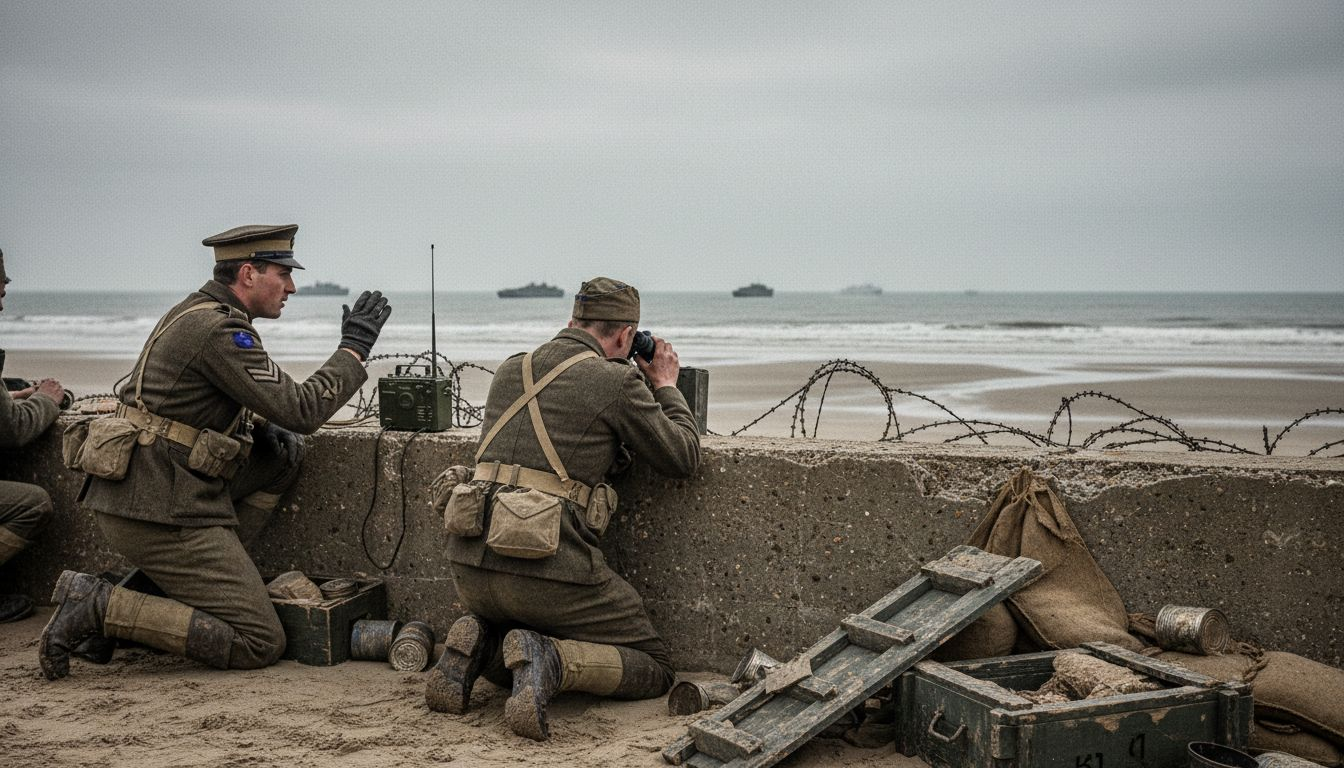
Post-war operations continued this trajectory. The Falklands War in 1982 proved definitively that the Royal Marines remained elite. Deployed 8,000 miles from home to retake islands occupied by a hostile force, they conducted amphibious landings under fire, fought across terrain designed for defence, and secured victory through superior tactics and absolute determination. That conflict demonstrated that Royal Marines training created soldiers capable of performing at the highest level regardless of circumstances. Beyond major conflicts, the Corps’ operations evolved to encompass peacekeeping missions, counter-insurgency campaigns, and humanitarian responses across the globe. They’ve served in Northern Ireland, Bosnia, Kosovo, Sierra Leone, Afghanistan, Iraq, and dozens of other locations. These operations underscore a critical reality: battle honours aren’t just about traditional warfare anymore. Modern Royal Marines conduct humanitarian missions, train local forces, counter piracy, and respond to natural disasters. Yet throughout this entire spectrum of operations, from World War I trenches to contemporary peacekeeping, the standard remains unchanged: excellence, adaptability, and unwavering reliability.
Here is an overview of important Royal Marines battle honours and the skills demonstrated during each:
| Conflict/Operation | Location | Skills Demonstrated | Lasting Impact |
|---|---|---|---|
| Gallipoli (WWI) | Turkey | Endurance under fire | Defined amphibious resilience |
| Zeebrugge Raids (1918) | Belgium | Audacious amphibious assault | Set standard for naval raids |
| WWII Amphibious Landings | North Africa, Sicily, Normandy | Combined arms tactics, adaptability | Elevated Commando reputation |
| Falklands War (1982) | South Atlantic | Long-range deployment, leadership | Cemented elite global status |
| Modern Peacekeeping | Worldwide | Multinational coordination | Expanded humanitarian remit |
Pro tip: When discussing your operational service with other veterans or younger serving personnel, contextualising your specific deployment within the broader arc of Royal Marines operations helps illustrate how your era’s challenges and achievements connected to the Corps’ centuries-long legacy of excellence.
Transition to commando role and elite status
World War II changed everything for the Royal Marines. Before the war, they were highly capable professionals performing traditional roles aboard naval vessels and supporting amphibious operations. Competent, certainly, but not fundamentally different from what they’d been doing for centuries. Then came the recognition that modern warfare demanded something different: specially trained forces capable of executing high-risk raids behind enemy lines, conducting amphibious assaults against fortified positions, and operating independently in small groups under extreme pressure. The British military responded by creating Commando units, and the Royal Marines seized this opportunity to redefine themselves entirely. This wasn’t a gradual evolution. It was a deliberate transformation. Selected personnel underwent rigorous specialist training designed to forge elite shock troops rather than general-purpose soldiers. These Commandos learned to operate in ways that conventional forces couldn’t match: rapid insertion, complex terrain navigation, precise timing, and the ability to accomplish missions with minimal support. The training was brutal. It was designed that way. The mentality being that if you could survive the training, you could survive the operations. And it worked. Royal Marines Commandos proved themselves repeatedly, earning a reputation for bravery and effectiveness that fundamentally elevated the entire Corps’ status within the British Armed Forces.
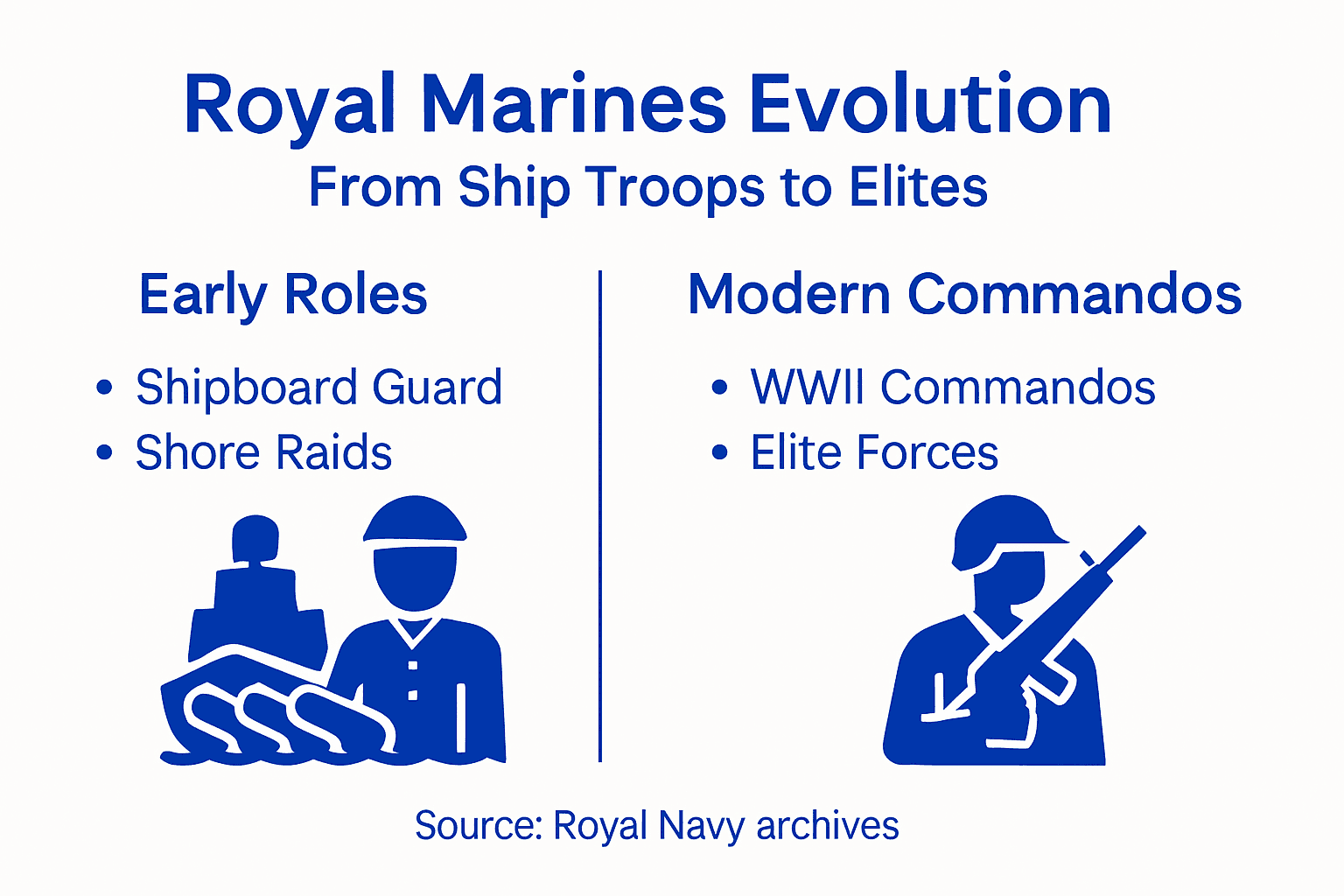
The Normandy invasion in 1944 demonstrated conclusively what Commando-trained Royal Marines could accomplish. Operating alongside Army Commandos and other specialist forces, they executed complex amphibious landings under devastating enemy fire, secured critical objectives, and advanced inland despite fierce resistance. What distinguished Royal Marines performance wasn’t just bravery. It was tactical excellence, leadership quality, and the ability to adapt plans when circumstances changed. Officers and non-commissioned officers thought on their feet, made decisions under pressure, and led their men to achieve the impossible. The Commando role fundamentally altered how the Royal Marines viewed themselves and how others viewed them. They were no longer shipboard troops with an amphibious capability. They were elite assault forces specialising in precision operations. Post-war, this identity didn’t diminish. If anything, it intensified. The transition to elite Commando specialisation established training standards and operational doctrine that remain core to the Corps today, including rigorous Arctic, amphibious, and expeditionary warfare capabilities.
The green beret became the physical symbol of this transition. Adopted after the war, it represented something profound: an identity distinct from the rest of the British military. Wearing that beret meant you’d met elite standards. You’d survived training that eliminated most candidates. You’d proven yourself capable of operating at levels that others couldn’t reach. This wasn’t arrogance. It was simply fact. The Falklands War in 1982 proved that the Commando transition hadn’t weakened the Corps. If anything, it had sharpened them. Deployed 8,000 miles from home, operating in terrain designed to defeat attackers, heavily outnumbered, the Royal Marines Commandos delivered victory through superior training, leadership, and determination. That conflict cemented their elite status permanently. From that point forward, no one questioned whether the Royal Marines were truly elite. They’d demonstrated it beyond argument. Since the 1980s, the Corps has continued adapting that Commando role to contemporary challenges. They’ve integrated high-technology warfare capabilities whilst maintaining the commando ethos. They’ve conducted unconventional warfare, counter-terrorism operations, and humanitarian missions. They’ve trained forces from allied nations in Commando techniques. Through every evolution, the fundamental identity established during World War II remains constant: elite warriors capable of accomplishing missions that other forces consider impossible.
Pro tip: If you transitioned into civilian roles post-service, your Commando training translates into problem-solving capabilities, leadership experience, and resilience that employers actively value; frame your military experience not as historical achievement but as demonstrated capability in high-pressure environments.
Living traditions and impact on veterans
The Royal Marines aren’t simply history. They’re a living institution with active traditions that connect you to something larger than yourself. These traditions exist because they matter. They bind generations together. When you served, you participated in rituals and practices that stretches back centuries. The way officers addressed the Corps. The ceremonies marking significant dates. The informal traditions within your unit. The standards expected in barracks and in the field. None of this was arbitrary. Each element reinforced the values that define the Royal Marines: courage, determination, and cheerfulness in adversity. What’s crucial to understand is that these living traditions didn’t die when you left active service. They continue. The Corps continues. Veterans remain part of the institution, connected to it through shared experience and shared understanding. That connection isn’t sentimental nostalgia. It’s fundamental to how many veterans maintain their sense of identity and purpose post-service.
Royal Marines museums and regimental events actively preserve these living traditions by creating spaces where the Corps’ values and history remain visible and accessible. These aren’t dusty museums where artefacts sit behind glass, disconnected from reality. They’re active institutions where veterans reconnect with their past, younger serving personnel understand their heritage, and the broader public grasps what the Royal Marines represent. When you attend a regimental event or visit a museum dedicated to the Corps, something shifts. You’re surrounded by others who understand what you experienced. You see artefacts from operations you heard about in briefings or read about in Corps history. You reconnect with the collective identity that shaped you during service. For many veterans, this reconnection proves profoundly important. It reinforces that your service mattered. That you contributed to something with genuine historical significance. That you’re part of a continuum extending back to 1664 and forward into an uncertain future.
The impact on veterans’ mental wellbeing and sense of community cannot be overstated. Military service creates bonds between people that civilian experiences rarely match. You trained together, worked under extreme pressure together, trusted each other with your lives. Those connections don’t simply evaporate when service ends. But they do require active maintenance. Regimental traditions and veteran gatherings provide the structure for that maintenance. They give you legitimate reasons to reconnect with people you served alongside. They create spaces where you’re understood without extensive explanation. When someone says they were Royal Marines, other veterans immediately grasp what that means: the training they endured, the standards they met, the values they embodied. This mutual understanding creates belonging. It supports mental wellbeing because it combats isolation. It gives you community with people who share your experiences and understand your perspective. For many veterans, maintaining these connections through regimental traditions becomes as important as any formal support service. It’s preventative. It’s proactive. It acknowledges that you remain part of something larger than yourself.
You might be wondering how to engage with these living traditions. Active participation matters more than passive observation. Attend regimental events when opportunity arises. Visit Corps museums and museums featuring Royal Marines operations. Support veteran organisations that maintain the traditions and community. Connect with other veterans through formal or informal networks. Share your experiences with younger serving personnel, helping them understand the heritage they’re joining. These actions aren’t frivolous. They’re how you maintain your own mental health and wellbeing whilst contributing to the institution that shaped you. The traditions matter because they connect you to a community of people who understand your perspective, share your values, and respect what you’ve accomplished. That connection sustains you through the challenges of civilian life in ways that might surprise you.
Pro tip: Engaging with how to gift for veterans and regimental memorabilia provides tangible ways to maintain your connection to Royal Marines traditions whilst honouring the service of your fellow veterans through thoughtful recognition.
Honour the Legacy of the Royal Marines With Meaningful Gifts
Understanding the deep history and living traditions of the Royal Marines reveals the immense pride and identity that veterans carry beyond their service. Many veterans face the challenge of preserving this unique connection to a Corps that values courage, determination and cheerfulness in adversity. Whether you are commemorating your own service era or seeking a special way to celebrate a fellow Marine, thoughtful memorabilia can bridge past and present.
Discover a curated selection in our Royal Navy Shop for gifts and presentation Royal Marines & Submariners designed specifically to honour the heritage and elite spirit of the Royal Marines. These carefully crafted items help keep living traditions alive while offering tangible ways to recognise service and sacrifice. Start your journey today at The Regimental Store and explore Featured Gift Ideas that resonate with your Royal Marines story. Celebrate your story with pride now while supplies last.
Frequently Asked Questions
What are the origins of the Royal Marines?
The Royal Marines originated from the necessity for soldiers to defend naval vessels in the 1660s. Established in 1664 as the Duke of York and Albany’s Maritime Regiment of Foot, they trained in both maritime and land combat, paving the way for their unique role in warfare.
How did the role of the Royal Marines change during World War II?
During World War II, the Royal Marines transformed from traditional shipboard troops to elite Commando forces. They developed specialised rapid-strike capabilities and executed complex amphibious landings, solidifying their reputation for bravery and tactical excellence.
What impact did the Falklands War have on the Royal Marines?
The Falklands War in 1982 cemented the Royal Marines’ elite status, showcasing their capability to conduct amphibious assaults successfully 8,000 miles from home under difficult conditions. This conflict reinforced their reputation as a versatile and elite fighting force in modern warfare.
How do living traditions benefit Royal Marines veterans today?
Living traditions provide a strong sense of community and belonging for veterans. By participating in regimental events and maintaining connections with fellow veterans, individuals can reinforce their shared values and experiences, which positively impacts their mental wellbeing and sense of identity.
Recommended
- Royal Navy Memorabilia Guide: Identify and Preserve Collectibles – The Regimental Store Ltd
- Royal Regiment of Scotland: Legacy and Modern Impact – The Regimental Store Ltd
- Complete Guide to the Meaning of Veteran Memorabilia – The Regimental Store Ltd
- How to Gift for Veterans: Honouring British Service – The Regimental Store Ltd