
Coldstream Guards History: Legacy, Traditions, and Role
Few British regiments spark as much fascination as the Coldstream Guards. For anyone passionate about military heritage, understanding their remarkable story explains why regimental memorabilia remains so prized. This elite unit’s continuous service since 1650 places them at the heart of four centuries of national history, marked by bold loyalty to the Crown and a legacy of distinguished battle honours. Collectors and historical enthusiasts will discover how the Coldstream Guards shaped Britain’s military tradition and why their artefacts command deep respect.
Table of Contents
- Origins And Formation Of The Coldstream Guards
- Key Campaigns And Battle Honours Explained
- Regimental Traditions And Ceremonial Roles
- Modern-Day Duties And Evolving Functions
- Significance In British Military Heritage
Key Takeaways
| Point | Details |
|---|---|
| Origins and Role | The Coldstream Guards were formed in 1650, serving both in combat and ceremonial roles, making them a unique entity in the British Army. |
| Historical Significance | The regiment has participated in numerous key conflicts, accumulating over 113 battle honours since its inception. |
| Ceremony and Tradition | They maintain rigorous ceremonial duties while demonstrating operational excellence, bridging historical tradition with modern military functions. |
| Modern Adaptation | Today, the Coldstream Guards serve as elite light role infantry specialists, reflecting the evolving needs of the British Army in contemporary warfare. |
Origins and Formation of the Coldstream Guards
The story of the Coldstream Guards begins in 1650 during one of Britain’s most turbulent periods. Raised in June 1650 by Colonel George Monck, a trusted military commander appointed by Oliver Cromwell, the regiment was formed as part of the New Model Army in Scotland. This wasn’t simply another military unit born out of necessity. Monck’s creation represented something far more significant—a fighting force that would eventually become the backbone of the restored monarchy’s protection. The regiment’s early years were marked by intense action. At the Battle of Dunbar in 1650, the Coldstream Guards fought with distinction, helping Monck consolidate power during the Commonwealth period. Yet what truly defined their character came a decade later when Britain faced the question of what would happen after Cromwell’s death and the collapse of the Commonwealth.
The year 1660 proved transformative. With England in chaos and without clear leadership, the Coldstream Guards undertook one of the most consequential marches in British military history. The regiment marched from Coldstream to London in that momentous year, their arrival becoming a turning point that helped restore law and order across the nation. More critically, they provided the military backing necessary to support the return of King Charles II and the restoration of the monarchy. This wasn’t a quiet administrative transition. The guards actively helped stabilise a fractured kingdom and demonstrated their loyalty to the Crown at precisely the moment when that loyalty mattered most. In recognition of their pivotal role during this period, the regiment earned lasting prestige and the personal favour of the restored king.
What makes the Coldstream Guards unique is their continuous service since 1650. Despite being the oldest continuously serving regiment in the British Army, they rank second in precedence behind the Grenadier Guards because the latter unit served the Crown for a longer initial period. Nevertheless, their claim to distinction remains undeniable. Throughout the 17th century alone, the regiment saw action defending Tangier against North African threats and fighting in Flanders during various European conflicts. This pattern of continuous deployment and service would define their trajectory through the centuries to come, establishing them not merely as ceremonial soldiers but as a genuinely battle-tested force with real operational experience.
Pro tip: If you’re collecting Coldstream Guards memorabilia or gifts honouring this regiment, understanding their foundational role in the 1660 Restoration helps you appreciate why items from their earliest period command such historical significance among collectors of British military heritage.
Key Campaigns and Battle Honours Explained
The Coldstream Guards have earned their reputation not through ceremonial duties alone, but through sustained action across nearly every major conflict the British Army has faced since 1650. Their battle honours span more than three and a half centuries of warfare. From the English Civil War through to modern operations, the regiment has consistently demonstrated battlefield excellence. The regiment has accumulated 113 Battle Honours and fourteen Victoria Cross awards, a testament to the extraordinary courage shown by individual guardsmen in the face of enemy fire. These aren’t merely historical accolades gathering dust in regimental archives. Each battle honour represents specific campaigns where the Coldstream Guards played decisive roles, often in conditions that tested their discipline, training, and character to the absolute limit.
Throughout their service history, the Coldstream Guards have fought in an astonishing range of theatres and conditions. The regiment saw action at Sedgemoor during the Monmouth Rebellion, held crucial positions during the War of Spanish Succession at places like Walcourt, and participated in the gruelling Siege of Namur in 1695. When the American colonies rebelled against British rule, the Coldstream Guards were there, fighting in North America during a conflict that fundamentally changed the political landscape. The Napoleonic Wars and Crimean War followed, each presenting different tactical challenges and testing the regiment’s ability to adapt. By the twentieth century, the Coldstream Guards had become so established in British military life that their presence in both world wars was almost inevitable. They fought across multiple continents during these global conflicts, experiencing trench warfare on the Western Front in the First World War and operations ranging from North Africa to Burma in the Second.
But their operational record didn’t end with 1945. The regiment continued to serve throughout the post-war period in ways many collectors and historians overlook. Operations in Palestine, Malaya, Kenya, and more recently Afghanistan demonstrate that the Coldstream Guards remained an active fighting force well into the twenty-first century. Each campaign added fresh names to the roll of honour and tested contemporary soldiers against modern threats. Understanding this continuity is crucial for appreciating why the regiment maintains such standing in British military culture. They haven’t simply rested on historical laurels. The traditions collectors and military heritage enthusiasts honour today were forged through real operations under genuine fire, generation after generation.
Here is a concise summary of major Coldstream Guards campaigns and their historical significance:
| Era | Campaign/War | Notable Contribution |
|---|---|---|
| 17th Century | Battle of Dunbar | Helped consolidate Cromwell’s rule |
| Late 17th Century | Siege of Namur | Defended British interests in Flanders |
| 18th Century | War of Spanish Succession | Secured key positions at Walcourt |
| 18th Century | North American Campaigns | Fought in American War of Independence |
| 19th Century | Napoleonic Wars/Crimea | Adapted tactics, saw combat at major battles |
| 20th Century | World Wars I & II | Served on multiple global fronts |
| Post-1945 | Palestine, Malaya, Kenya, Afghanistan | Supported modern British operations |
Pro tip: When acquiring Coldstream Guards memorabilia or gifts commemorating specific campaigns, cross reference the battle honours to verify authenticity and understand the historical context, which significantly enhances both the collectible value and personal meaning of such pieces.
Regimental Traditions and Ceremonial Roles
When most people think of the Coldstream Guards, the image that comes to mind is almost certainly a soldier in a bearskin cap standing motionless outside a royal palace. Yet this iconic ceremonial presence represents only one facet of a regiment whose identity has been shaped by centuries of evolving traditions. The Coldstream Guards are renowned for their high-profile ceremonial roles protecting royal residences including Windsor Castle and Buckingham Palace. These aren’t simply decorative postings. Guarding the monarch and royal palaces involves rigorous protocols, strict training standards, and a level of discipline that reflects the regiment’s continued operational excellence. What distinguishes the Coldstream Guards from other regiments is how they seamlessly transition between active combat operations and state ceremonial duties. A soldier might find themselves in Afghanistan one year and performing Trooping the Colour the next, maintaining the same professional standards in both environments.
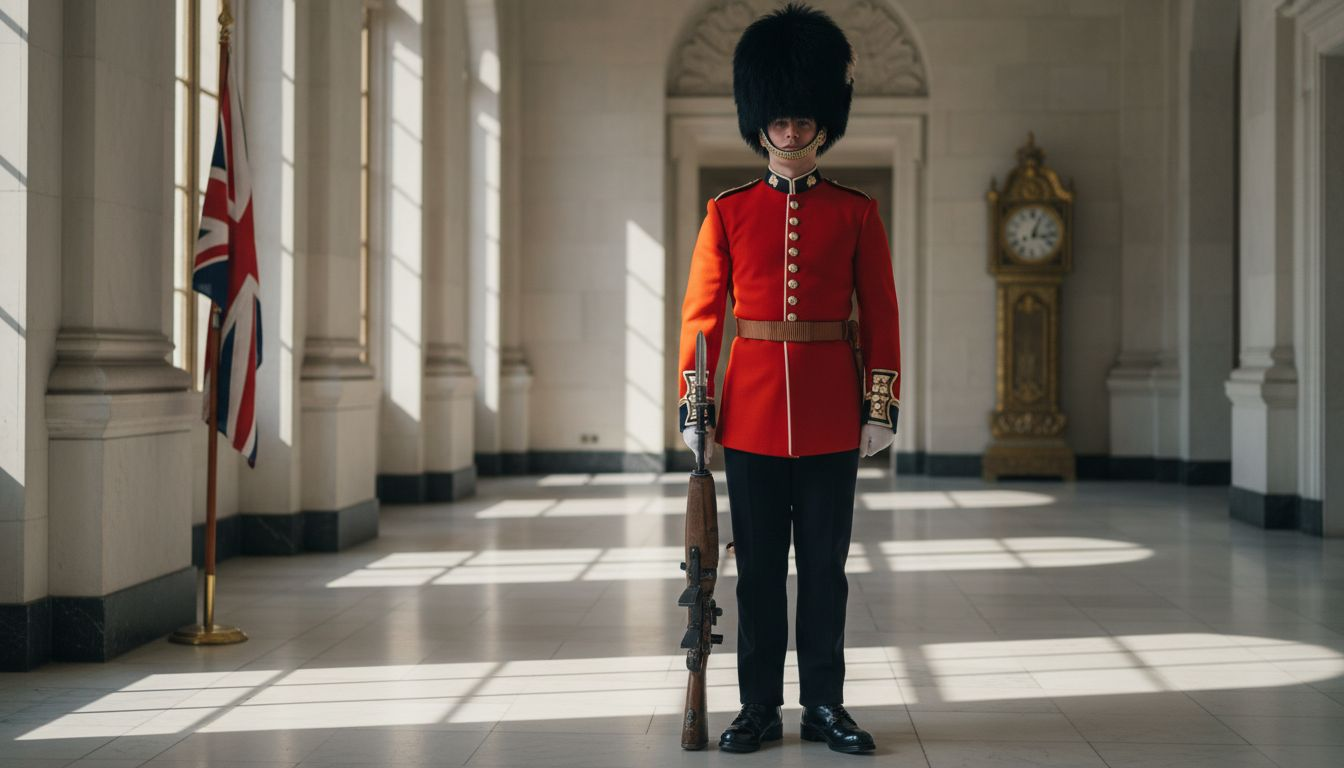
The distinctive visual identity of the Coldstream Guards communicates their history as powerfully as any spoken account. Their cap badges, uniforms, and the Order of the Garter star they wear represent tangible links to past centuries. The Order of the Garter star adorning their uniforms was a symbol awarded to their first Colonel by King Charles II himself, a personal mark of royal favour from the moment of the Restoration. This isn’t mere decoration. Collectors and military heritage enthusiasts recognise that these uniform elements serve as physical reminders of the regiment’s foundational role in restoring the monarchy. Every button, every insignia, carries meaning rooted in specific historical events. The regimental band, established officially in 1785, is one of the oldest military bands and represents another enduring tradition that has outlasted empires and political upheaval.
The ceremonial calendar of the Coldstream Guards revolves around major public events that showcase their role in British state life. Trooping the Colour, the formal parade that celebrates the monarch’s official birthday, features the Coldstream Guards prominently and draws thousands of spectators annually. Their involvement in state occasions, from coronations to state funerals, ensures that the regiment remains woven into the fabric of British constitutional life. These ceremonies aren’t performances in a theatrical sense. They represent continuity and stability during moments of national significance. The precision, the pageantry, and the sheer visual impact communicate something profound about institutional continuity and respect for tradition. For collectors acquiring Coldstream Guards memorabilia, understanding these ceremonial roles adds significant context to uniform items, badges, and regimental gifts. A dress uniform piece tells a different story when you know the occasions for which it was worn.
This table compares ceremonial and operational roles of the Coldstream Guards in different periods:
| Period | Ceremonial Role | Operational Role |
|---|---|---|
| Restoration Era | Guarded royal residences | Restored monarchy, stabilised nation |
| 19th Century | Public ceremonies, parades | Colonial campaigns, conventional wars |
| Modern Era | Trooping the Colour, state occasions | Reconnaissance, rapid deployment missions |
Pro tip: When collecting Coldstream Guards ceremonial items, research the specific uniforms worn for different occasions (state ceremonies versus everyday palace guard duties) as items associated with historic state events command considerably higher value among serious collectors.
Modern-Day Duties and Evolving Functions
The Coldstream Guards of today operate in a world radically different from the one their predecessors inhabited centuries ago. Yet despite technological advances and shifting geopolitical landscapes, the regiment remains fundamentally committed to the dual role that has defined them since the Restoration: maintaining both operational excellence and ceremonial distinction. Currently, the Coldstream Guards serve as elite light role infantry specialists equipped with advanced reconnaissance capabilities, machine gun systems, and mortar support. This operational profile reflects the modern British Army’s need for flexible, rapidly deployable forces capable of responding to diverse threats. A contemporary guardsman undergoes training that would astound soldiers from even the Second World War era. They master cutting-edge surveillance equipment, operate advanced weapons systems, and engage in complex tactical scenarios involving urban operations and counter-insurgency. The reputation the Coldstream Guards earned through centuries of combat operations isn’t something they merely preserve in museums. Active soldiers carry that legacy forward by performing at the highest standards in twenty-first century warfare.
What makes the modern Coldstream Guards particularly valuable to the British Army is their proven ability to transition seamlessly between combat deployments and home-based duties. A squadron might spend months conducting reconnaissance operations in hostile terrain, then return to the United Kingdom and assume palace guard responsibilities within weeks. This flexibility demands exceptional discipline and professionalism. Every soldier must master both the technical skills required for contemporary warfare and the exacting standards expected during ceremonial duties. The rifle drill, the parade ground precision, the unblinking vigilance outside Buckingham Palace, these aren’t quaint throwbacks to military tradition. They represent a deliberate training philosophy that reinforces professionalism and attention to detail. These same qualities translate directly to operational effectiveness in the field.
The regiment’s role in the British Army’s broader force structure has shifted considerably over recent decades. Rather than forming the backbone of pitched battles and colonial campaigns, the Coldstream Guards now specialise in reconnaissance and rapid response operations where their training and equipment give them particular advantages. They operate light vehicles and engage enemy forces with precision weaponry in tactical situations requiring speed and situational awareness. Recent operations in Afghanistan and other theatres have tested this specialisation against genuine modern threats. The experiences gained in these deployments feed directly back into training programmes, ensuring the regiment continually evolves its capabilities. For military heritage collectors, understanding these modern roles adds important context to contemporary Coldstream Guards memorabilia and gifts. Uniform items, operational patches, and regimental insignia from recent decades tell stories of soldiers adapting ancient traditions to contemporary challenges.
Pro tip: When collecting modern-era Coldstream Guards items from recent operations, seek pieces with verified deployment documentation and unit insignia from specific operational theatres, as these authenticated items significantly outvalue generic contemporary merchandise among serious military heritage collectors.
Significance in British Military Heritage
The Coldstream Guards occupy a uniquely important position within British military heritage. The regiment is the oldest continuously serving unit in the British Army with origins tracing back to the English Civil War era of 1650. This distinction carries weight far beyond chronological precedence. The Coldstream Guards have literally witnessed the transformation of Britain from a Commonwealth without a monarch to a constitutional monarchy, through imperial expansion, industrial revolution, world wars, and into the modern era. No other British regiment can claim such an unbroken thread connecting them to every major period of national military development. When collectors and military heritage enthusiasts speak of the Coldstream Guards, they’re discussing far more than a single unit. They’re referencing a living institutional memory of British military evolution itself.
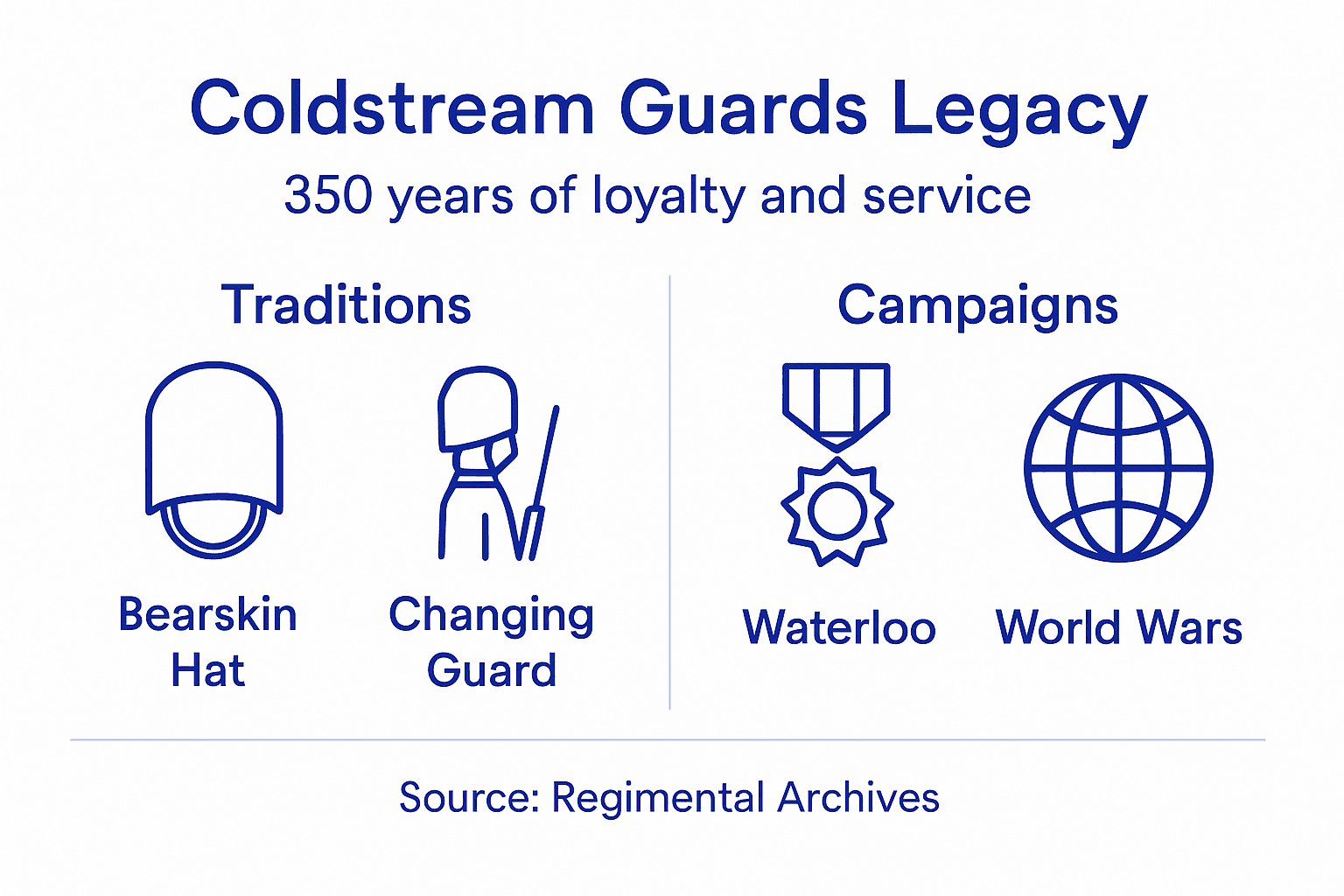
What truly underscores the regiment’s heritage significance is the substance of their service record. With over 113 battle honours and multiple Victoria Cross holders, the Coldstream Guards exemplify the very highest standards of British military tradition and valour. These aren’t abstract numbers on a regimental roll of honour. Each battle honour represents specific moments where the regiment proved itself under genuine fire. Each Victoria Cross marks an act of extraordinary courage by an individual soldier. The accumulated weight of these achievements means that when the Coldstream Guards march past a crowd or stand guard at a royal residence, they carry with them the collective memory of four centuries of sacrifice and service. This is why seemingly mundane items like regimental badges, uniform buttons, and ceremonial insignia hold such profound meaning for collectors. They represent tangible connections to historical events and the soldiers who lived through them.
The Coldstream Guards have consistently combined frontline infantry roles with ceremonial duties supporting the monarchy, a balance that has shaped their character throughout their existence. They fought at Dunbar and Sedgemoor, held positions in Flanders and Tangier, endured the grinding campaigns of the Napoleonic Wars, and faced mechanised warfare in both world conflicts. Yet throughout this relentless operational record, they maintained their role as guardians of the Crown and protectors of royal residences. This dual identity is unusual among British regiments. Many units specialised entirely in combat operations or ceremonial duties, but the Coldstream Guards mastered both. Their presence in major historical campaigns from the seventeenth century to contemporary operations reflects their enduring legacy and profound influence in shaping British military history. For those interested in British military heritage, the Coldstream Guards represent something essential: the continuity of institutional excellence across centuries of profound change. Understanding their story means understanding how the British Army itself has evolved and adapted across nearly four hundred years.
Pro tip: When acquiring Coldstream Guards memorabilia, items bearing regimental badges and insignia from specific historical periods command substantially higher values than generic items, as they serve as authenticated markers of the regiment’s presence during particular campaigns and eras.
Honour the Legacy of the Coldstream Guards with Authentic Gifts
The Coldstream Guards embody a proud heritage built on centuries of unwavering loyalty and battlefield excellence. If you cherish the regiments legacy and wish to celebrate its rich traditions, shop gifts and presentation products for all the UK Guards Regiments crafted to respect their historical significance and ceremonial prestige. Whether you are a collector or seeking a meaningful tribute, find items that connect you to this iconic regiments story, from regimental badges to unique memorabilia.
Explore our carefully curated selection that reflects the Coldstream Guards continuous service and modern-day duties. Act now to acquire authentic pieces that honour both their operational courage and ceremonial role. Start your journey at The Regimental Store Ltd to discover gifts that carry the spirit of the Coldstream Guards and elevate your collection today.
Frequently Asked Questions
What are the origins of the Coldstream Guards?
The Coldstream Guards were raised in June 1650 by Colonel George Monck as part of the New Model Army in Scotland, playing a significant role in the restoration of the monarchy when they marched from Coldstream to London in 1660.
How many battle honours have the Coldstream Guards earned?
The Coldstream Guards have accumulated 113 battle honours and fourteen Victoria Cross awards, showcasing their extraordinary courage and participation in various conflicts since their formation.
What is the significance of the Coldstream Guards in British military history?
The Coldstream Guards are the oldest continuously serving regiment in the British Army and have witnessed major national transformations, demonstrating exceptional service across four centuries and embodying the continuity of British military heritage.
What are the modern roles of the Coldstream Guards?
Today, the Coldstream Guards serve as elite light role infantry specialists with advanced reconnaissance capabilities, balancing operational duties with ceremonial responsibilities, reflecting their adaptability in contemporary military contexts.
Recommended
- Royal Regiment of Scotland: Legacy and Modern Impact – The Regimental Store Ltd
- The Royal Highland Fusiliers: A Scottish Tradition T-shirt – The Regimental Store Ltd
- Regimental System Explained: Heritage and Daily Impact – The Regimental Store Ltd
- Parachute Regiment History: Britain’s Airborne Legacy – The Regimental Store Ltd
- Role of Art in Family Legacy: Lasting Bonds – The Family Portrait Companys